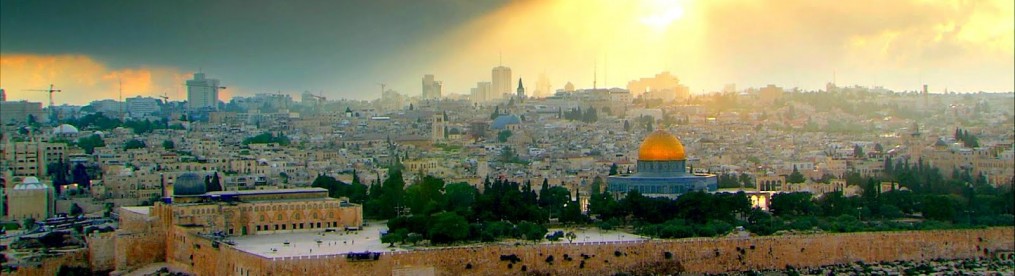
The Nations Shall Seek the LORD in Jerusalem
And the word of the LORD of hosts came to me, saying, 19 “Thus says the LORD of hosts: The fast of the fourth month, and the fast of the fifth, and the fast of the seventh, and the fast of the tenth, shall be to the house of Judah seasons of joy and gladness, and cheerful feasts; therefore love truth and peace.
“Thus says the LORD of hosts: Peoples shall yet come, even the inhabitants of many cities; 21 the inhabitants of one city shall go to another, saying, ‘Let us go at once to entreat the favor of the LORD, and to seek the LORD of hosts; I am going.’ 22 Many peoples and strong nations shall come to seek the LORD of hosts in Jerusalem, and to entreat the favor of the LORD. 23 Thus says the LORD of hosts: In those days ten men from the nations of every tongue shall take hold of the robe of a Jew, saying, ‘Let us go with you, for we have heard that God is with you.’”Zech. 8:18-23
The Fasts
FYI: For the dates of Holy Days, please see: Jewish holiday calendars & Hebrew date converter
Tzom Tammuz:
The fast of the ninth of Tammuz, Tammuz is the fourth month of the Hebrew calendar, it is the first month of summer, roughly equivalent to June/July of the Georgian calendar. This fast commemorates the breaching of the walls of Jerusalem by Nebuchadnezzar.
On the ninth day of the fourth month the famine was so severe in the city that there was no food for the people of the land. 4 Then a breach was made in the city; the king with all the men of war fled by night by the way of the gate between the two walls, by the king’s garden, though the Chaldeans were around the city. And they went in the direction of the Arabah. 2 Kings 25:3-4
Tisha B’Av:
The fast of the fifth month is the Ninth of Av, and is roughly equivalent to the Gregorian month of July. This fast commemorates the two destructions of the Temple, both Solomon’s and Herod’s, which fell to the armies sent by God to destroy it, on this day.
The Destruction of Jerusalem is in 2 Kings 25:8ff; and Jer. 52:12ff. These two passages do not exactly agree on the date of the destruction of the city; the former has it on the seventh, the latter on the tenth of the month. The Jews explain the discrepancy by saying that the Babylonians entered the temple on the seventh and profaned it until the ninth, when they set it on fire and left it to burn until the tenth. CJ. Rodkinson, Babylonian Talmud; Ta’anith, 86.
Yom Kippur:
The fast of the seventh month is the Day of Atonement, the holiest day in the cycle of Levitical Feast.
And the LORD said to Moses, 27 “On the tenth day of this seventh month is the day of atonement; it shall be for you a time of holy convocation, and you shall afflict yourselves and present an offering by fire to the LORD. 28 And you shall do no work on this same day; for it is a day of atonement, to make atonement for you before the LORD your God. 29 For whoever is not afflicted on this same day shall be cut off from his people. 30 And whoever does any work on this same day, that person I will destroy from among his people. 31 You shall do no work: it is a statute for ever throughout your generations in all your dwellings. 32 It shall be to you a sabbath of solemn rest, and you shall afflict yourselves; on the ninth day of the month beginning at evening, from evening to evening shall you keep your sabbath.” Lev. 23:26 -32.
Asara B’Tevet:
Asara B’Tevet is the Tenth of Tevet, Tevet being roughly equivalent to January. This fast commemorates the beginning of the siege of Jerusalem by Nebuchadnezzar.
And in the ninth year of his reign, in the tenth month, on the tenth day of the month, Nebuchadnezzar king of Babylon came with all his army against Jerusalem, and laid siege to it; and they built siegeworks against it round about. 2 Kings 25:1
Do We Fast?
Of these fasts, Yom Kippur is the only one required by Torah. The others have all been added by tradition. They are purely about mourning for the temple and the loss of Jerusalem. They are a remembrance that because the people had so corrupted the Light. The LORD himself sent the nations to destroy it all.
At the time of the writing, they were rebuilding that temple. But all the visions of Zechariah are about building this temple as well as the typology of the coming kingdom age , with a coming spiritual temple. When the Light is no longer a lampstand kept inside the temple of bricks and stone, but rather the Light of Messiah in us, shining out to a world in darkness.
Joy and Gladness, and Cheerful Feasts
In Hebrew, it is sasson, smicha, and tov. Words that are used for celebrations. Sasson, smicha means joy and gladness or gladness and joy. Tov means good; tov is in the plural, meaning really good. The meaning is plain that these fasts are to be converted into days of thanksgiving with all the food and dancing that a celebration involves. Our redemption is complete. For too long, Jews and the inherited churches have given their people long faces, penitences, and denials; it is time to celebrate our salvation.
The Kingdom Age
Unfortunately, the inherited churches have renamed the Kingdom Age as the Church Age or the Age of Grace. This clouds the teachings of both John the Baptist and Messiah Himself. For they both taught that “The kingdom was at hand.” NOT DELAYED! During this Kingdom Age, these fasts were to become a time of feasting and celebrating, for we have a more perfect temple, a spiritual one.
But when Christ appeared as a high priest of the good things that have come, then through the greater and more perfect tent (not made with hands, that is, not of this creation) Heb. 9:11
The temple is now gone, the shadow is no more. There is no more mourning, only rejoicing. It was understood by all, that during the time of the tabernacle or later, the temple, the sacrifices were insufficient. This is made clear here in the book to the Hebrews. The sacrifices were meant to be shadows of the completed work of salvation at the crucifixion.

After the Golden Calf incident, according to the Rabbis, “The Holy One who is the heart of Israel summons the people onc1e more to draw near unto Him, knocking at the door, as it were, and expressing a wish to dwell amidst them. . . . Zedah La-derekh notes that what God is seeking here is not entering into the sanctuary but into their hearts. The use of the plural pronoun’ among them’ instead of the singular ‘in it’ (referring to the sanctuary Ex. 25:8 ) is meant to teach us that:
The Divine presence does not rest in the sanctuary on account of the sanctuary, but on account of Israel, for they constitute the Temple of God.” Studies in Shemot by Nehama Leibowitz. The World Zionist Organization, 1983 pg 463
Now we come to the hard-to-explain part. Although in English it seems quite clear that a future time with a literal temple is the subject, the Hebrew is far more supportive of a typological interpretation.
. . . the inhabitants of one city shall go to another, saying, ‘Let us go at once to entreat the favor of the LORD, and to seek the LORD of hosts; I am going.’ Zech. 8:21
This translation indicates that the people are just traveling to the city. But in Hebrew, the word for “walk” is in the verse four times. Somehow, the translators thought that three “goes” would do, instead of the four “walks.” However, the Hebrew concept of walking is not necessarily the same as going. In Hebrew, “to walk” means to obey the commandments. As we walk with the LORD. The verse is primarily about the walking, not the arriving.
FYI: In Hebrew, one will ask “what is the walk for this or that law?” meaning how does one fulfill the commandment? The answer may be simple or complicated, depending on which law is being addressed.
For in the day that I brought them out of the land of Egypt, I did not speak to your fathers or command them concerning burnt offerings and sacrifices. But this command I gave them, ‘Obey my voice, and I will be your God, and you shall be my people; and walk in all the way that I command you, that it may be well with you.’ Jer. 7:22-23
The meaning of the verse is to dwell in the walk, not the city. And we walk and dwell one with another as we are going on our way. We are walking to seek the face of the LORD of Hosts. Just as He had taught the children of Israel to walk, He now extends this same instruction to the nations.
“Hear, O Israel: The LORD our God is one LORD; 5 and you shall love the LORD your God with all your heart, and with all your soul, and with all your might. 6 And these words which I command you this day shall be upon your heart; 7 and you shall teach them diligently to your children, and shall talk of them when you sit in your house, and when you walk by the way, and when you lie down, and when you rise. 8 And you shall bind them as a sign upon your hand, and they shall be as frontlets between your eyes. 9 And you shall write them on the doorposts of your house and on your gates. Deut. 6:4 -9
The people who walked in darkness have seen a great light; those who dwelt in a land of deep darkness, on them has light shined. Is. 9:2
. . . the people who sat in darkness have seen a great light, and for those who sat in the region and shadow of death light has dawned.” Matt. 4:16
Zechariah 8:21 ends with the little phrase “I am walking”. This is now our job. We are to walk in the LORD. Our goal is not the Old Jerusalem of bricks and stones, but rather the New Jerusalem with streets of gold and no sun, for God will be our Light. As the people at the time of Zechariah were getting ready to be able to travel to Jerusalem, a place of worship and communion with God. There is yet a spiritual temple where one is in the presence of God always.
22 And I saw no temple in the city, for its temple is the Lord God the Almighty and the Lamb. 23 And the city has no need of sun or moon to shine upon it, for the glory of God is its light, and its lamp is the Lamb. Rev. 21:22-23
Seeking the LORD
22 Many peoples and strong nations shall come to seek the LORD of hosts in Jerusalem, and to entreat the favor of the LORD. 23 Thus says the LORD of hosts: In those days ten men from the nations of every tongue shall take hold of the robe of a Jew, saying, ‘Let us go with you, for we have heard that God is with you.’”
The word “robe” here, referring to the edge or hem of the garment, is where the tzitzi or tassels are tied.
“Speak to the people of Israel, and bid them to make tassels on the corners of their garments throughout their generations, and to put upon the tassel of each corner a cord of blue;” Num. 15:38
. . . came up behind him, and touched the fringe of his garment; and immediately her flow of blood ceased. Luke 8:44
It would be absurd to think of ten men going around literally hanging on to one man’s garment, let alone just the edge of it. Ten men in Hebrew is a minion. In order to establish a synagogue, or even to say corporate prayers, a minimum of ten righteous men is needed. (In more modern congregations, they now count the women as well.) But there must be ten. These, however, are not Jewish men. These men of probity from every tribe and nation seek to hold on to the Jewish Messiah.
Then he said, “Oh let not the Lord be angry, and I will speak again but this once. Suppose ten are found there.” He answered, “For the sake of ten I will not destroy it.” Gen. 18:32
Moses chose able men out of all Israel, and made them heads over the people, rulers of thousands, of hundreds, of fifties, and of tens. Ex. 18:25
They have come to cleave to the only one who knows the way. There is only one who can bring peace between God and man, or who can cover our nakedness. There is no other by which men are saved. The Jew whose hem to whom one must cleave is Messiah’s. The “many people” can be from any time, and obviously, any place. The “Jew” they are cleaving to Messiah Himself. For it is only He who can bring men to God.
And a woman who had had a flow of blood for twelve years and could not be healed by any one, came up behind him, and touched the fringe of his garment; and immediately her flow of blood ceased. Luke 8:43-44
And there is salvation in no one else, for there is no other name under heaven given among men by which we must be saved.” Acts 4:12
It is to Messiah we look. It is to Messiah we cling. Our walk seeks to please Him.
His master said to him, ‘Well done, good and faithful servant; you have been faithful over a little, I will set you over much; enter into the joy of your master.’ Matt. 25:23
Pingback: In the Harem there is Peace from War | The Song of Songs
Pingback: Tisha B’Av – From the Congregation of Biet Sepher