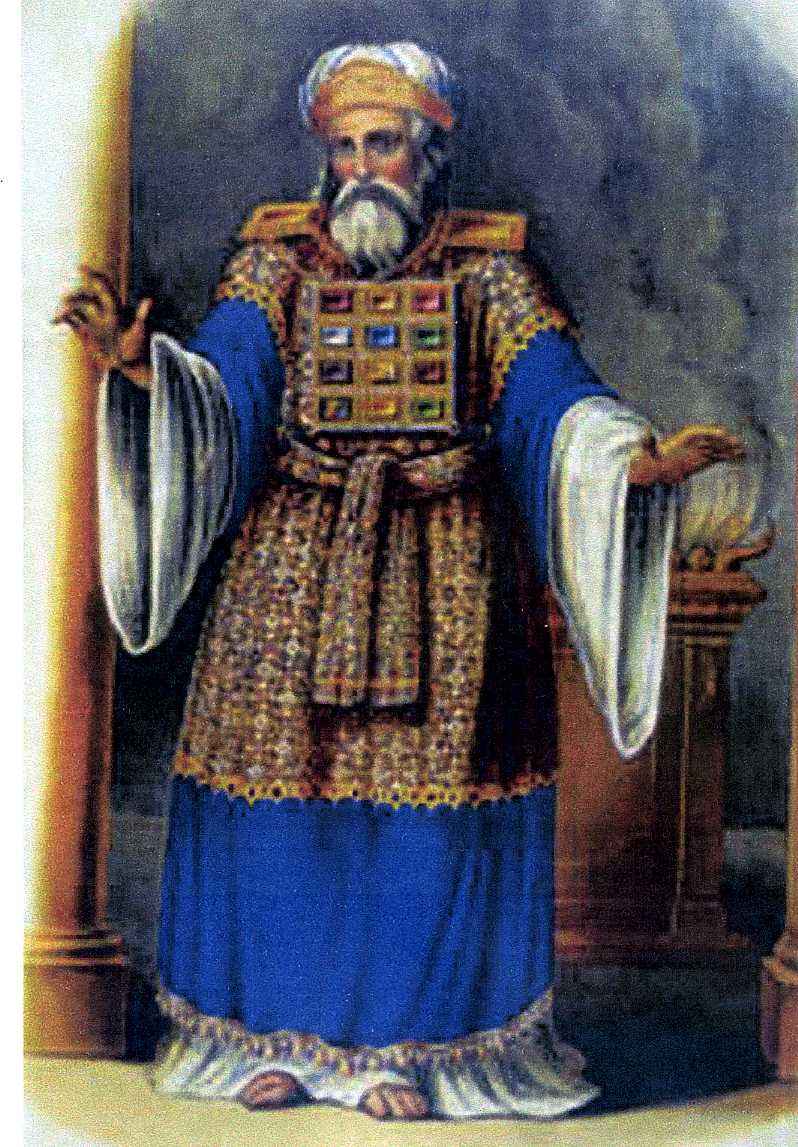
1 Then he showed me Joshua the high priest standing before the angel of the LORD, and Satan standing at his right hand to accuse him. 2 And the LORD said to Satan, “The LORD rebuke you, O Satan! The LORD who has chosen Jerusalem rebuke you! Is not this a brand plucked from the fire?” 3 Now Joshua was standing before the angel, clothed with filthy garments. 4 And the angel said to those who were standing before him, “Remove the filthy garments from him.” And to him he said, “Behold, I have taken your iniquity away from you, and I will clothe you with rich apparel.” 5 And I said, “Let them put a clean turban on his head.” So they put a clean turban on his head and clothed him with garments; and the angel of the LORD was standing by.
6 And the angel of the LORD enjoined Joshua, 7 “Thus says the LORD of hosts: If you will walk in my ways and keep my charge, then you shall rule my house and have charge of my courts, and I will give you the right of access among those who are standing here. 8 Hear now, O Joshua the high priest, you and your friends who sit before you, for they are men of good omen: behold, I will bring my servant the Branch. 9 For behold, upon the stone which I have set before Joshua, upon a single stone with seven facets, I will engrave its inscription, says the LORD of hosts, and I will remove the guilt of this land in a single day. 10 In that day, says the LORD of hosts, every one of you will invite his neighbor under his vine and under his fig tree.” Zech 3:1-10
This passage’s primary emphasis is on Israel being restored, or cleansed, as a priestly nation to serve the LORD. The LORD showed Zechariah the fourth of eight visions that seem to have occurred on the same night. This vision encourages Zechariah to understand the high priest Joshua’s position in the LORD, and a more distant promise that the LORD’s servant, the Branch, will remove all sin in one day and that the nation will dwell in peace.
Satan Stands Accusing Joshua
Satan acts as the accuser of the brethren, standing in the court of God to bring forth charges against Joshua. Rev 12:10] The scene resembles a divine courtroom, where accusations fly freely until the Angel of the Lord intervenes. With a commanding Hebraic phrase, “The Lord rebuke you,” the angel effectively silences Satan, emphasizing that God’s court is one of order and justice. In this divine tableau, Joshua is presented as a man rescued from a fiery trial, symbolizing his emergence from the furnace of Babylonian exile. Though he cannot cleanse himself of his own guilt, those present—perhaps priests and angels—symbolically cleanse him, signifying God’s restorative grace. This act underscores that Joshua’s salvation and service are rooted in divine mercy, not personal merit, highlighting God’s sovereignty and His compassionate redemptive plan for His people amidst their affliction.
FYI: Ezra 10:18 states that Joshua had sons who had taken wives that were not lawful, heathens and non-Israelites. Israel may not have been engaged in idolatry, but there was still uncleanness, especially in the priesthood.
FYI: Joshua was a common name, meaning”The Lord Saves.” Joshua is spelled Jeshua in Ezra 2:2 and Nehemiah 7:7. In English, it was translated as Jesus.
Clean Clothes
Joshua stands in contrast to the last church of the Church or Kingdom age, Laodicea. Our age! Our letter calls us poor, pitiable, naked, and blind. Unlike Joshua, we have not been given clean clothes; we must buy or put effort into our eternal state.
Therefore I counsel you to buy from me gold refined by fire, that you may be rich, and white garments to clothe you and to keep the shame of your nakedness from being seen, and salve to anoint your eyes, that you may see. Rev. 3:18
The LORD states that by taking away Joshua’s filthy clothes, he has taken away his sin. Not only by removing his sin, but the LORD then clothes Joshua in the richness of righteousness. A clean turban, the head covering of a priest, is next placed upon Joshua. He is cleansed and ready to serve the LORD. Joshua is given the same offer that our Lord gives all His followers. “If you will walk in my ways and keep my charge, then you shall rule my house and have charge of my courts, and I will give you the right of access among those who are standing here.”
The Branch
The angels are commanded by the LORD, to take off Joshua’s filthy garments. Joshua stands as a type for all believers who must be cleansed from all sin to be clothed with the LORD’s righteousness. We all can become Kings and Priests of the Most High God [Rev 1:6, 5:10]. In this way, Joshua and his fellow priests are men symbolic of things to come, as stated in verse 8.
My servant, the Branch, is a messianic title familiar to Zechariah, Joshua, and all of Israel. Found in Isaiah 4:2, it is also related to “the shoots” of Isaiah 11:1 and 53:2 (out of the roots of Jesse; Jer 23:5 and Jer 33:15: a righteous Branch and King out of David, the LORD, our Righteousness). This messianic title is also found in Zechariah 6:12, where the Branch will rule as a priest on a throne.
The Branch has Seven Attributes
1 There shall come forth a shoot from the stump of Jesse, and a branch shall grow out of his roots. 2 And the Spirit of the LORD shall rest upon him, the spirit of wisdom and understanding, the spirit of counsel and might, the spirit of knowledge and the fear of the LORD. 3 And his delight shall be in the fear of the LORD. Is. 11:1-2
The Spirit of the LORD shall rest upon him,
The spirit of wisdom
Understanding,
The spirit of counsel
Might,
The spirit of knowledge
The fear of the LORD
The Stone
He is also a single stone, with seven facets. The stone is a messianic title.[Ps 118:22-23, Isa 8:13-15; 28:16; Dan. 2:35, 45; Mt 21:42, Eph 2:19-22; 1 Pet 2:6-8]. We are not told what is engraved on the facets. seven is a number of completion.
The LORD will engrave an inscription on that stone, reminiscent of cutting a covenant to remove the sin of this land. Infinitely omniscient, the seven eyes on that one stone bear testimony to the LORD who sees all.
In that day [the day of the LORD: Isa 2:11, 17, 20], a glorious day of celebration will cause each one in Israel to “sit under his vine and fig tree”. This pastoral picture is one of peace, security, and contentment; the Branch has provided redemption. [2Kings 18:31; Mic 4:4] Some say that this referred to the “Days of Messiah,“ but it is yet to be fully realized at the LORD’s return [see Zech 12:10-13:1] when He rules as Prophet, Priest, and King. In Zech 12:10-13:1, we have a more complete view of what will happen “in that day” as they look upon the one whom they pierced, and Grace is poured out upon the inhabitants of Jerusalem.
The high priest bore the names of Israel upon the stones in his breastplate.
In a single day: on the cross. In verse 9, we see a future day in which all sin will be removed from the land. Land is used here as a metaphor for all of Israel.