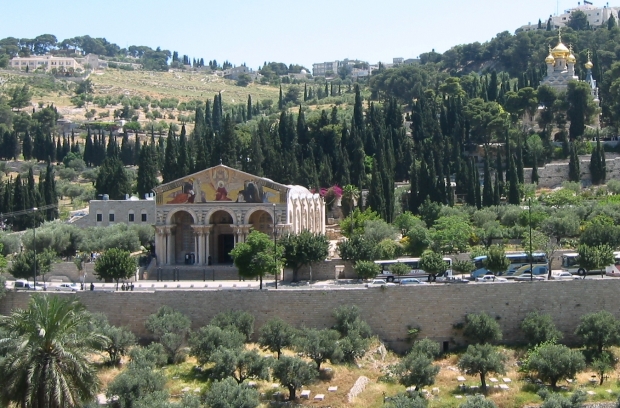
3 As he sat on the Mount of Olives, the disciples came to him privately, saying, “Tell us, when will this be, and what will be the sign of your coming and of the close of the age?” Matthew 24:3
3 And as he sat on the Mount of Olives opposite the temple, Peter and James and John and Andrew asked him privately, 4 “Tell us, when will this be, and what will be the sign when these things are all to be accomplished?” Mark 13:3-4
7 And they asked him, “Teacher, when will this be, and what will be the sign when this is about to take place?” Luke 21:7
All three passages ask the same questions, slightly differently. Luke’s passage is perhaps the most clear recitation of the disciples’ questions asked that night. It is of the greatest importance to place the context of this passage into what the disciples thought was being said by Messiah. And, they believed the Lord was replying to their questions “when” and “what” in the context of the destruction of the temple – that very same temple they had just been admiring.
They wanted to know when the temple would be left “not one stone upon another,” and what they were to look for, i.e., the signs that indicated this was about to happen. They were not asking about the Return of the Lord, as they didn’t understand yet that He was going to leave them. There is absolutely no sense that they understood that the Temple would be destroyed to be rebuilt to be destroyed again!
Later in each of their texts, Matthew, Mark and Luke also mention the prophecy of Daniel 9; key to when Messiah comes as the instrument of judgment. This clearly places the context of this passage about the surrounding of Jerusalem by armies, and the total destruction of the city and the Temple.
The First Question: When?
The general belief of the Jewish people of the first century, including the disciples, was that “The Days of the Messiah” would mean the end of the Roman Empire and the beginning of a glorious Jewish Age. Never had they envisioned the possibility that the end of the Jewish polity was imminent. All that Messiah had taught in these last few days was a complete shock.
43 Therefore I tell you, the kingdom of God will be taken away from you and given to a nation producing the fruits of it.” Matt. 21:43
Everything Messiah had said was completely at odds with what the people believed was about to happen to their kingdom. The disciples would have been stunned! Naturally, they wanted to know if this desolation was going to happen to them and their people. [Luke 19:41-44]
The Roman armies under General Titus surrounded and ultimately destroyed Jerusalem and the Temple (67AD-70AD) – this is history. There is no debate that both the city and the temple were destroyed.
Your Coming?
The signs of the Lord’s coming involve the appearance of false Messiahs, wars, famines and pestilences, earthquakes, etc. In a subsequent post, we will begin to address each of these signs through their historic fulfillment.
For now, we are going to discuss an often-misunderstood aspect of this text: what is your “coming”? The scripture takes for granted that when the destruction happens, it is the Lord coming to make it happen! This sovereignty over the affairs of all men is often written as coming, coming in the clouds, or coming from above. It is a literary device to indicate the power in the Heavens.
Coming in the clouds of heaven is a common symbolism found in the Old Testament. The disciples would know it well, and they used it in their writings. The phrase is a figure of speech, a polysyndeton.
Coming does not always mean the physical presence of God on earth. Quite frequently, it means judgment or the presence of God from above. To be sure, when the disciples heard that Messiah was coming, they did not think it was good tidings of great joy for the city. They understood in the context of the destruction of the Temple, the term meant judgment.
What God does is always righteous. However, God’s people in the midst of judgment are not always having a pleasant time.
When God came to look at the tower of Babel, it meant that they were about to be judged [Gen 11:5-8]. He scattered His people.
When God came to look at Sodom and Gomorrah, it meant that God was about to judge the two cities [Gen 18:21]. Lot and his family were rescued.
Ex 3:8; Ps 50:3; Isa 64:1-3; Isa 66:15; Zech. 9:9; Mic 1:3-4, 5:2.
Total Fulfillment of Destruction in 70 AD or includes The Second Coming
Many believe that there are two comings of the Son of Man in Matthew 24. The first (24: 1-28) is about the destruction of Jerusalem and the Temple, which was fulfilled in 70AD. The second coming on the clouds of Heaven is about His Second Coming as written in Matthew 24:29-51. They contain different languages and use coming differently.
The Lord appears to know when the first coming is, as it is related to Jerusalem’s destruction in Daniel 9. The judgment will be “quick” as lightning.
For as the lightning comes from the east and shines as far as the west, so will be the coming of the Son of man. Matt. 24:27
This first coming of the Son of Man [Matt. 24:27] does not use the words “in the clouds.” It was coming in judgment from above, against Israel through Roman armies. It would be a time of tragedies and troubles, ending in many deaths. The end of the Jewish kingdom would come on the heels of the utter destruction of Israel and her diaspora throughout the world.
The Kingdom of God was to be enlarged through a kingdom of all who would call on the name of the Lord; a kingdom that included male and female, Jewish and Greek. The destruction would usher in the true Messianic Age.
Messiah said [Matt. 24:36] only the Father knows when this (second) “coming on the clouds of heaven with power and great glory” is going to occur. The second coming is about the Lord’s Second Return to rule and reign forever. He will not destroy; He will be seen by all; He sends angels; the fig tree will put forth fruit again. This is a coming to rule and reign, not a time of death and destruction. This is very much unlike His first “coming.”
The faithful and wise servant, whom His master made ruler in His absence, is ready for His return. No running from, but to, Jerusalem here!
. . . then will appear the sign of the Son of man in heaven, and then all the tribes of the earth will mourn, and they will see the Son of man coming on the clouds of heaven with power and great glory; Matt. 24:30
. . . and they did not know until the flood came and swept them all away, so will be the coming of the Son of man. Matt. 24:39
But know this, that if the householder had known in what part of the night the thief was coming, he would have watched and would not have let his house be broken into. Matt. 24:43
Therefore you also must be ready; for the Son of man is coming at an hour you do not expect. Matt. 24:44
But if that wicked servant says to himself, ‘My master is delayed,’ Matt. 24:48
These two comings, along with other contextual clues, indicate that Matthew 24 is divided into two distinct sections.
Total Fulfillment of Matthew 24
On the other side of the coin, many believe that the entire chapter 24 of Matthew refers to the destruction of Jerusalem in 70AD, and there is nothing unfulfilled or typological here. Messiah came in judgment using the Roman Armies to destroy the city and temple, just as He had used the Babylonian armies to destroy the first temple and city.
In 70 AD, the people of Jerusalem anticipated divine intervention to save them from the invading Romans. They believed their faith and prayers would shield them, yet they failed to recognize the significance of their rejection of the Messiah. Just as the tender spring branches of a fig tree can be swiftly snapped, so too was the city engulfed by the overwhelming strength of four Roman legions. The rapidity of this conquest, symbolized by lightning, signaled how swiftly judgment would come—a warning realized in the shortest of sieges. Within just four months, the Romans breached the Eastern Wall, bringing the city to its knees and fulfilling the prophecy with astounding immediacy.
Messiah did not give a date when this would happen. There is, however, a time limit to this prophecy. It follows a Biblical pattern of 40 years of trial and judgment.
And the LORD’s anger was kindled against Israel, and he made them wander in the wilderness forty years, until all the generation that had done evil in the sight of the LORD was consumed. Num. 32:13
From Messiah’s ministry to the destruction of Jerusalem and the Temple was 40 years!