18 Then the LORD became jealous for his land, and had pity on his people. 19 The LORD answered and said to his people, “Behold, I am sending to you grain, wine, and oil, and you will be satisfied; and I will no more make you a reproach among the nations. Joel 2:18-19
Prophecy is often written as if it all already happened, in the past tense, in English. The “became jealous” is in the piel tense in Hebrew, which is a causative tense. The Lord will cause Himself to become jealous.
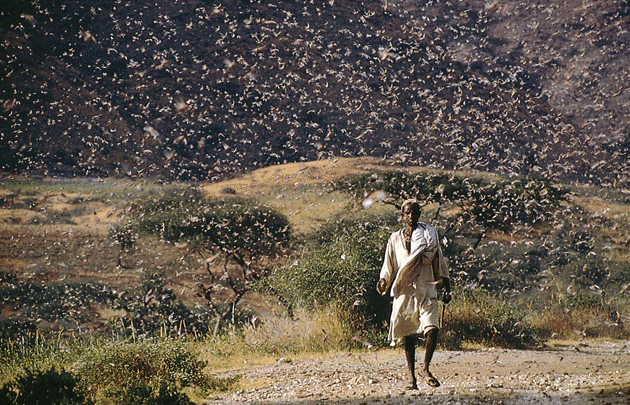
20 “I will remove the northerner far from you, and drive him into a parched and desolate land, his front into the eastern sea, and his rear into the western sea; the stench and foul smell of him will rise, for he has done great things. Joel 2:20
In the ancient world, the cardinal directions were perceived differently from how we understand them today. The primary cardinal direction was not north but east. This orientation significantly influenced the strategic positioning of ancient civilizations, particularly in regions like ancient Judea. According to this perspective, the front was considered to be located to the east, while the rear was positioned to the west.
In the context of ancient Judea, the understanding of cardinal directions had profound implications for defense strategies. Enemies typically approached from the south, primarily from Egypt, or from the north, coming from various nations. However, it was nearly impossible for armies to invade ancient Israel from the east due to the vast Jordanian desert that lay between them.
This unique geographical configuration is reflected in Biblical texts such as Daniel and Joel, where the invading forces are described metaphorically. In Daniel 2, these invading armies are compared to metals, symbolizing different nations or empires. Similarly, in Daniel 7, they are depicted as beasts, representing diverse groups or kingdoms. However, Joel specifically notes that no enemies come from the south (Egypt), indicating that the primary threat was from the north or east.
The imagery of these invading locust armies being driven into the Mediterranean Sea is a vivid representation of the military strategies employed during those times. This narrative also raises questions about the specific reference to the “eastern sea.” Traditionally, this has been interpreted as the Dead Sea, but some scholars argue that it could refer to the Persian Gulf. The ambiguity surrounding this term adds a layer of complexity to the understanding of these ancient texts and their historical contexts.
The ancient perception of cardinal directions, particularly the emphasis on the east as the primary direction of invasion, provides valuable insights into the defensive strategies and military tactics of ancient civilizations. Understanding these nuances helps in interpreting Biblical texts more accurately and appreciating the strategic significance of geographical orientations in ancient warfare.
Threshing Floor
The “foul stench” of the decaying carcasses has no known parallel in Prophecy. So it is left to conjecture as to what this means.
21 “Fear not, O land; be glad and rejoice, for the LORD has done great things! 22 Fear not, you beasts of the field, for the pastures of the wilderness are green; the tree bears its fruit, the fig tree and vine give their full yield. Joel 2:21
The destruction caused by the locust is not permanent; once they are gone, the fertility of the land will return.
23 “Be glad, O sons of Zion, and rejoice in the LORD, your God; for he has given the early rain for your vindication, he has poured down for you abundant rain, the early and the latter rain, as before. Joel 2:23
Ancient Judea relied upon rain for its crops, as there was no great river to draw irrigation from. There was no great river like the Nile or the Tigris. The early and latter rains come in the Fall and the Spring, respectively.
24 “The threshing floors shall be full of grain, the vats shall overflow with wine and oil. 25 I will restore to you the years which the swarming locust has eaten, the hopper, the destroyer, and the cutter, my great army, which I sent among you. Joel 2:24
In ancient Judea, they grew what we call winter wheat, which is planted in the fall and harvested in the spring. The damage the locusts have done will be restored.
In the modern Western world, the concept of threshing floors is largely unfamiliar to most people. This is due in large part to the mechanization of agriculture, which has replaced traditional methods with more efficient and faster techniques such as combine harvesters. However, understanding the historical and practical significance of threshing floors provides insight into ancient agricultural practices and the ingenuity of early farmers.
Threshing floors were flat, open areas typically situated on elevated ground where the grain was processed after harvesting. These locations were strategically chosen for their topography, often situated on hills or ridges where the wind was constant but not overly strong. The primary purpose of these floors was to separate the grain from the chaff—dried plant material that surrounds the seeds.
The process of threshing involved throwing the harvested grain into the air using a flail or a sledgehammer. As the grain was tossed aloft, the wind would blow away the lighter chaff, leaving behind the heavier grains. This method required patience and labor, as each sheaf of grain had to be broken down individually and then scattered across the floor. Farmers would often work in teams, rotating through different roles to ensure the process was efficient and thorough.
The choice of location for threshing floors was critical. Elevated positions provided an advantage because they allowed for better airflow, which facilitated the separation of chaff from grain. Additionally, the higher ground could help protect the harvested crops from potential flooding during rainy seasons. The constant yet gentle breeze on these elevated sites played a crucial role in the threshing process, ensuring that the chaff could be effectively removed without damaging the grain.
Today, while threshing floors may seem like relics of the past, they offer valuable lessons in sustainable agriculture and resource management. The principles underlying these ancient techniques can inspire modern farmers to adopt more environmentally friendly practices, such as reducing reliance on heavy machinery and promoting natural processes.
While the use of threshing floors is no longer common in the modern agricultural landscape, understanding this practice offers a glimpse into the ingenuity and resilience of early farming communities. By recognizing and applying these traditional methods, contemporary agriculture can continue to evolve in a way that respects both historical wisdom and modern needs.
Grapes were trodden out by feet in winepresses, which were hewn out of rocks. There was an upper vat and a shallow lower vat where the juice collected. The lower vat is what is meant by the text.
The choice of location for threshing floors was critical. Elevated positions provided an advantage because they allowed for better airflow, which facilitated the separation of chaff from grain. Additionally, the higher ground could help protect the harvested crops from potential flooding during rainy seasons. The constant yet gentle breeze on these elevated sites played a crucial role in the threshing process, ensuring that the chaff could be effectively removed without damaging the grain.
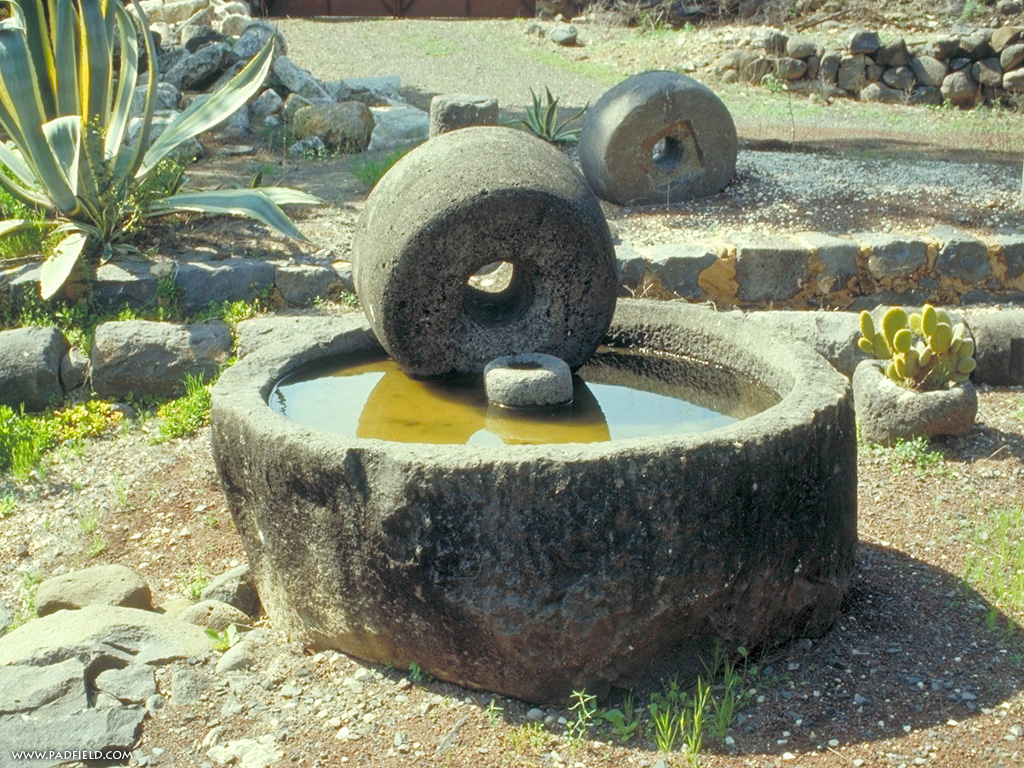
Olives are pressed using the same process as the ancients did; the only real difference is that they used a large stone, and modern operations use steel.
26 “You shall eat in plenty and be satisfied, and praise the name of the LORD your God, who has dealt wondrously with you. And my people shall never again be put to shame. 27 You shall know that I am in the midst of Israel, and that I, the LORD, am your God and there is none else. And my people shall never again be put to shame. Joel 2:26
When the locusts are gone, the fertility of the land will return, and they will eat of it. The last of these nations have run their course. Rome is a shadow of itself. The Jews have built a nation in their ancesteral land. The fertillity has returned. From other prophecies we wait for Israel to return.