The Coming of The Greeks
1 An Oracle
The word of the LORD is against the land of Hadrach and will rest upon Damascus. For to the LORD belong the cities of Aram, even as all the tribes of Israel; 2 Hamath also, which borders thereon, Tyre and Sidon, though they are very wise. 3 Tyre has built herself a rampart, and heaped up silver like dust, and gold like the dirt of the streets. 4 But lo, the Lord will strip her of her possessions and hurl her wealth into the sea, and she shall be devoured by fire.5 Ashkelon shall see it, and be afraid; Gaza too, and shall writhe in anguish; Ekron also, because its hopes are confounded. The king shall perish from Gaza; Ashkelon shall be uninhabited; 6 a mongrel people shall dwell in Ashdod; and I will make an end of the pride of Philistia. 7 I will take away its blood from its mouth, and its abominations from between its teeth; it too shall be a remnant for our God; it shall be like a clan in Judah, and Ekron shall be like the Jebusites. 8 Then I will encamp at my house as a guard, so that none shall march to and fro; no oppressor shall again overrun them, for now I see with my own eyes.
Chapters 9-14 encompass two interconnected oracles that present a unified prophetic message. The first oracle depicts the Messiah as the rejected king—one who, despite rejection and suffering, ultimately emerges triumphant [Zech 9:1-11:17]. This section emphasizes his humility and the seeming triumph of opposition, yet it points forward to his divine vindication. The second oracle shifts focus, revealing that this very rejected king will become the enthroned king. The “King of kings” who is established in His sovereignty and power [Zech 12:1-14:21]. These two oracles, though stylistically distinct from earlier messages of comfort and encouragement, form a cohesive prophecy of hope amid rejection. Because of their length and complexity, we will explore these passages in smaller segments to better understand their depth and significance.
The last chapter pronounced judgments on the surrounding city-states that caused all the delays and struggles of the people to rebuild the city and temple. This oracle shifts its focus from the people’s present conditions to the anticipated arrival of the Messiah and His mission. In Zechariah’s writings, complemented by Isaiah 53 and Daniel 9, we find some of the most comprehensive prophetic descriptions of the Messiah—detailing His identity, the timing of His coming, and the scope of His ministries.
FYI: The word “masa,” translated as “oracle,” is a homonym in Hebrew; it can mean either oracle or burden. The Hebrew language lends itself to a lot of word play, and the Scritures are full of such amusments. These word plays, or puns, are called PARONOMASIA. Jeremiah uses this same word to tell the people off when the people ask, “What is the oracle of the Lord,” and are told that “they are His burden.”[Jer. 23:33]
The word of the LORD is His burden or a burden to these “peoples” that have plagued the children of Israel. These pronouncements upon Judah’s enemies are the result of the four chariots of Zechariah 6 with red, black, white, and dappled horses patrolling the earth before judgment. It is as if He has had enough of them. The weight of the chariot judgments is now resting upon them. Here, we will link the judgment of the city-states to those patrolling chariots.
FYI: The patrolling horse of Zechariah 1 and the judgments on Judah’s enemies in Zech. 9:1-8

In Zechariah 1:8, we were presented with a man riding on a red horse who was later identified as the LORD. The patrolling horses report that the earth is at rest, and the angel asks the LORD how long Jerusalem will be unanswered (verse 12) or unavenged. In verse 14, His jealousy for Jerusalem and for Zion will result in His anger at these nations who are at ease. And again, in verse 21, the LORD would cast down the nations who “lifted up their horns, or power, against the land of Judah to scatter it (See Also: Zechariah 1:18-19 The Four Horns and the Four Smiths)
EAST COUNTRY Zechariah 6:1-6, chariots with red horses, Persia at Peace
In Zechariah 6, chariots with red (adam) horses are mentioned coming out between two mountains, but do not appear to be sent patrolling. The implication is that the empire was already judged – Babylon was no longer. In Zechariah 9:1-8, we see no judgment upon any peoples from the East.
NORTH COUNTRY Zechariah 6:6, chariots with black horses; Judgment upon Hadrach

Zechariah 9:1-4 addresses the judgment upon the land to the north of Judah, while the eyes of men, especially Israel, are watching the cities: Hadrach, Damascus, Hamath, Tyre, and Sidon. Special mention is made of Tyre and Sidon’s “wisdom” in building an impressive port empire and their wealth; however, the LORD will tear down and throw them into the sea.
We also learn of the judgment on the enemies of Judah and Israel, who they are, and what specific judgment is being meted out to them.
The City-States

Hadrach was the capital of the principality of Lu’ash, southwest of Aleppo. “Until recent times, there had been considerable uncertainty as to the identification of Hadrach in Zec. 9:1, but the Zakir Stele discovered at Hamath refers to the city of the Hazrek (or Hadrach) as the capital of the principality of Lu’ash. It lay southwest of Aleppo and north of Hamath. It seems that Lu’ash contracted an alliance with Hamath and succeeded in defeating Benhadad II of Damascus.“ A Survey of the Old Testament Introduction by Gleason Archer Jr., Moody Press, Chicago: 1975.
Damascus is one of the oldest continuously inhabited cities in the world. It is presently the capital of modern Syria.
Hamath’s name means fortification; it is on the Orontes River in present-day Syria.
A large sign which marks the ancient city of Tyre as protected cultural property according to the 1954 Hague Convention for the Protection of Cultural Property in the Event of Armed Conflict

Tyre was a Phoenician port city in what is now Lebanon. There is a modern city of the same name north on the coast. The original ancient city is in ruins (in the sea) and is a UNESCO World Heritage Site. Tyre is marked by a large sign according to the 1954 Hague Convention for the Protection of Cultural Property in the Event of Armed Conflict.
Sidon was a port city and the ancient capital of Phoenicia. It is halfway between Tyre and Beirut in modern Lebanon.
WEST COUNTRY Zechariah 6:6, chariots with white horses, or the Rising Greek Power
The chariot with the white horse is mentioned in Zechariah 6:6 as going towards the west. There is no empire or nation to the west of Judah. In fact, the West is in the Mediterranean Sea. The sea at the time of Zechariah was, for all intents and purposes, the realm of the Phoenician/Canaanites. They ran their large trading empire out of Tyre.
Judgment Comes
Judah was always surrounded by enemies. Many of the ancient enemies had also fallen to the Babylonians. Those that remain are singled out for judgment. This first part of the oracle is largely concerned with the coming judgment on these city-states, in the form of an invasion by the Greeks under Alexander in 332 B.C. At the time of Zechariah’s writing, the Persian Empire was at rest; but that rest is about to end. The countries that are now Syria, Lebanon, and the Gaza Strip were about to face the invading troops of Alexander the Great. The white horses and chariots go toward the western country [Zech 6:6] or the Mediterranean Sea. The power controlling trade on the Mediterranean is about to shift from the Phoenicians, whose nerve center was at Tyre and Sidon, to the Greeks. This change in the fortunes of nations caused the Phoenicians to relocate their cultural and economic interests to Carthage.
The rest ended with Xerxes III, who made one of those great blunders in history. He decided to invade Greece. He crossed the Aegean Sea to poke the sleeping dragon, Greece, in the eye. In a battle that Hollywood has now made famous, “The Battle of the 300”, just 300 men held off the Persian army until the Spartans and the Greek fleets could arrive to stop the invasion. Xerxes fled back to his palaces, where he spent the rest of his reign amusing himself with his harem.
But he had stirred up the Greeks. They now understood that they could not continue as separate city-states; they needed to unite to protect themselves from another invasion. Philip of Macedon set out to do just that, and upon his death, turned a nearly unified kingdom over to his son, Alexander.

In 334 BC, Alexander crossed the Hellespont to invade the Persian Empire. Alexander’s army crossed the Cilician Gates in 333 BC and defeated the main Persian army under the command of Darius III at the Battle of Issus in November 332 BC.
In one of the most famous battles in history, Tyre fell in 332 BC. The ancient city of Tyre was situated in two parts, a mainland town and an island fortress off the coast of what is now Lebanon. Alexander’s men dismantled the mainland town and built a causeway out to the island, taking seven months to do so. The island, now a small peninsula, has never been rebuilt.
After this defeat, the Phoenicians moved their center of operations to Carthage in northern Africa. Those who remained in Tyre rebuilt their city a little north of the old, as the causeway changed the currents and made the area around what had been Tyre too shallow. The new Tyre continued to be an important shipping center until the Muslims arrived.
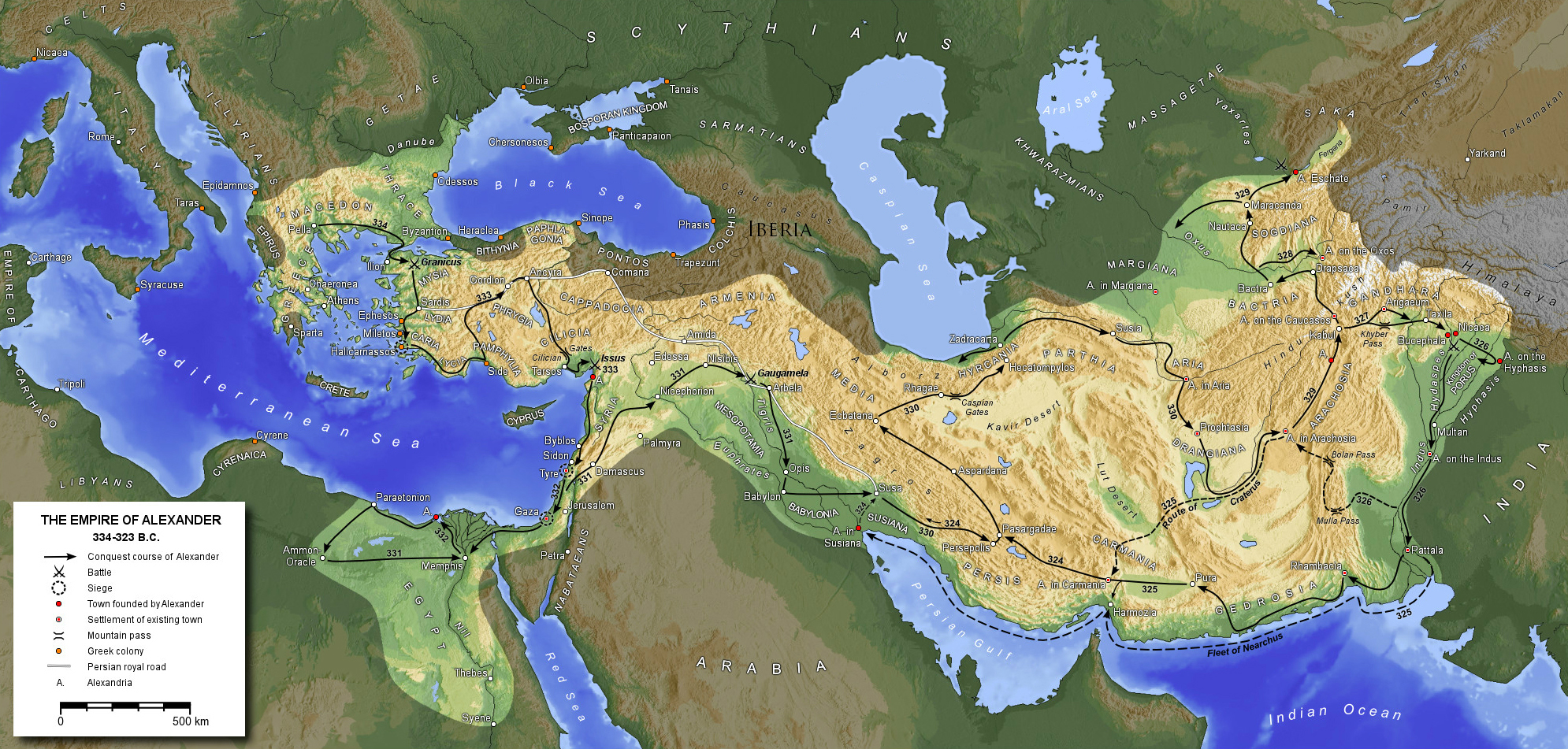
Alexander then went south into Egypt, where he was welcomed on November 14, 332 BC. They went so far as to anoint him pharaoh in Memphis. Leaving Egypt in 331 BC, Alexander marched eastward into Mesopotamia (now northern Iraq) and again defeated Darius III at the Battle of Gaugamela. He went on to invade what is now Afghanistan and India in 326 BC, and died in Babylon in 323 BC. Upon his death, the Empire was split between 4 of his Generals.
SOUTH COUNTRY Zechariah 6:6, chariots with dappled horses; Ashkelon, Gaza, Ekron, and Ashdod
The Philistines had five cities on the coastal plain in what is now called the Gaza Strip: Ashkelon, Gaza, Ekron, Ashdod, and Gath. (Gath is not mentioned in this prophecy because it wasn’t inhabited at that time.)
The Philistines had been a thorn in the side of the people of Israel for centuries. Even the great Samson did not destroy them, nor did Saul or David. They lasted until Hezekiah smote them [2 Kings 18:8] and then disappeared from the historical record. Assyrian or Egyptian records do not mention them after this, so one must conclude that Hezekiah smote them thoroughly.
Here in Zech 9:6, it says that the area is inhabited by a mongrel people, most likely a group of people planted by the Greeks to “colonize”. The Hebrew is more earthy and calls them “mamzer,” which the English translates as bastard. These are not the Philistines, not the warrior giants of the famed Goliath and his brothers. These are people who have moved into the area after the Philistines were “smote.”
As Alexander moved down the coast toward Egypt, any city that did not surrender was wiped out. This must have caused great anguish to those living further down the coast, witnessing one great city after another fall to the Greeks. It’s recorded that Alexander the Great besieged Gaza, the last city to resist his conquest on his path to Egypt, for five months before finally capturing it in 332 BC. The inhabitants were either killed or taken captive. Alexander then brought in local Bedouins to repopulate the city and organized it into a polis, or “city-state”. After the Greeks arrived, Ashkelon became an important Hellenistic seaport. Ashdod prospered under the Hellenistic rule.
The LORD says that Ekron will no longer desire to attack Judah, and they will no longer continue in their abominations or their hatred of Judah. They will no longer prey upon the Jews, but rather become like a clan of Judah, a remnant people. Ekron shall be like the Jebusites, or a people who cannot be driven out, and continued to live beside the Jews until they were absorbed into the nation.

Gates of Ashdod, or what is left of them
That is indeed what happened under the Hasmoneans. Ashdod became part of Judea during the Hasmonean Revolt. Judas Maccabeus arrived at its gates, but did not conquer it. He left it for his brother Jonathan, who conquered it in 147 BC. He then destroyed the Temple of Dagon. I will take away its blood from its mouth, and its abominations from between its teeth, is a reference to idolatrous sacrifices and forbidden food from ceremonially unclean animals that were offered at the temple by the Greeks. In the end, Ashdod also became part of the Hasmonean Kingdom.
All these cities were judged: the Assyrian cities, the Canaanite/Phoenician cities, as well as the cities of Philistia. The LORD guarded Judah, and no conqueror overran them; they were not oppressed. Oppressed is the same Hebrew word as “slave-drivers” or “the taskmasters” of Egypt.
God protected them from the great wrath of these empires. The nations around them were gone, never to return. The enemies that Saul and David had known were removed from their places. After the Hasmoneans took back the temple, there were very few problems with the Greeks. All went well for the small nation of Judah until they rejected their Messiah, as we shall see.