And I lifted my eyes and saw, and behold, a man with a measuring line in his hand! 2 Then I said, “Where are you going?” And he said to me, “To measure Jerusalem, to see what is its breadth and what is its length.” 3 And behold, the angel who talked with me came forward, and another angel came forward to meet him, 4 and said to him, “Run, say to that young man, ‘Jerusalem shall be inhabited as villages without walls, because of the multitude of men and cattle in it. 5 For I will be to her a wall of fire round about, says the LORD, and I will be the glory within her.’”
Ho! ho! Flee from the land of the north, says the LORD; for I have spread you abroad as the four winds of the heavens, says the LORD. 7 Ho! Escape to Zion, you who dwell with the daughter of Babylon. 8 For thus said the LORD of hosts, after his glory sent me to the nations who plundered you, for he who touches you touches the apple of his eye: 9 “Behold, I will shake my hand over them, and they shall become plunder for those who served them. Then you will know that the LORD of hosts has sent me. 10 Sing and rejoice, O daughter of Zion; for lo, I come and I will dwell in the midst of you, says the LORD. 11 And many nations shall join themselves to the LORD in that day, and shall be my people; and I will dwell in the midst of you, and you shall know that the LORD of hosts has sent me to you. 12 And the LORD will inherit Judah as his portion in the holy land, and will again choose Jerusalem.”
Be silent, all flesh, before the LORD; for he has roused himself from his holy dwelling. Zech. 2:1-13
The Measuring
We are presented with a young man who is measuring Jerusalem. Jerusalem is measured or “sized up” by a young man. He is not identified, nor are his measurements given. In fact, an angel informs the young man that the city will be too big to be walled. Its size will be too large due to the number of exiles who are and will be encouraged to return from Pagan Babylon and Papal Babylon. The city is described as vast and glorious. We will not hear of the measurement till The Revelation chapter 21.
15 And he who talked to me had a measuring rod of gold to measure the city and its gates and walls. 16 The city lies foursquare, its length the same as its breadth; and he measured the city with his rod, twelve thousand stadia; its length and breadth and height are equal. 17 He also measured its wall, a hundred and forty-four cubits by a man’s measure, that is, an angel’s. Rev. 21:15-17
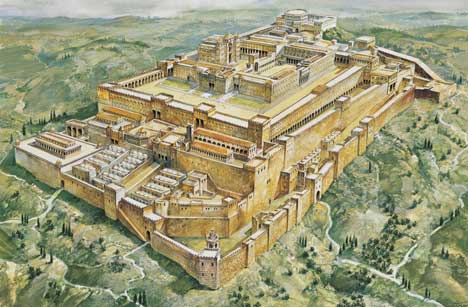
We have now stepped into typology. The returning exiles may have seen the city and temple as small, but the LORD promissses the He will build His holy temple and city on a grander scale. And, He will be in the midst of His people. This is not the little temple of Zerubbabel, nor is it the fabulous temple of Herod. This temple is the completed design that mere mortals could never achieve. As Zechariah struggled to build the little temple, we struggle just to build our temple of the Holy Spirit. We struggle to keep it clean. Yet when the Lord brings it all together with everyone who ever called on His name present, we will make a truly glorious, magnificent, triumphant city.
FYI: Ezekiel also has measurements, a temple and land, but not a city. Ezel 41-45 c.f.Jer. 31:38; Zech 4.
Villages without Walls
The city is villages without walls. (Another indication that this is not literal but rather typological.) A city without walls was unheard of in the ancient world. No matter the size, they needed walls to protect them from flaming arrows and barbaric hordes with battering rams. This was true until the advent of gunpowder. No wall of bricks or stones could withstand cannon fire. So the LORD assures them that in the absence of walls, He will be a fire “round” the city like the fire in Exodus between the Egyptian army and the fleeing Israelites. [Ex 14] The LORD declares He will be in her midst as the protection they need. This was true throughout the reconstruction period of Zechariah and Zerubbabel. Although they were rebuilding in “troublesome times” as Daniel had predicted [Dan 9:25], they were never openly attacked.
Escape to Zion
The LORD calls His people to flee from Babylon and all the other nations where He has scattered them. This escape serves a dual purpose: a physical departure during the vision and a spiritual return to their God. More importantly, it signifies leaving behind Pagan Babylon spiritually and returning to Zion, where the LORD desires to dwell with His people and be worshipped. The journey to Zion symbolizes turning away from false worship rooted in Pagan Babylon—the origin of spiritual corruption.
The vision is both contemporary to Zechariah in its immediate physical sense, and also in a prophetic future grandeur. As a type, the immediate restoration of Judah and the temple is contrasted with its antitype, the future of the New Jerusalem with many nations gathered there, and the glory of the LORD will be present forever.
This vision resonates both in its immediate context with Zechariah, symbolizing the restoration of Judah and the rebuilding of the temple, and in its prophetic future, depicting the grandeur of the New Jerusalem. In this future, many nations will be gathered there, and the glory of the LORD will dwell forever among His people, signifying eternal peace and divine presence.
FYI: The Bible always speaks of Babylon being in the north. This is because in order to travel there, one must first go north to the River Euphrates before turning east and traveling down the river. There was just no thought of going due east and attempting to cross the desert.
FYI: Throughout the Bible, Babylon symbolizes the root of all idol worship and false beliefs. From Genesis to Revelation, Babylon stands as a symbol of humanity’s tendency to turn away from the true God and into idolatry. All this is traceable back to the rebellion and pride exemplified in the Tower of Babel and Nimrod’s legacy. Across cultures and ages, the universal story of a flood, a mighty hunter, and the struggle against the sky god reflects a shared human experience—an attempt to understand and overcome the chaos of the world with stories of heroism and defiance. In pagan traditions, the serpent often appears as a symbol of wisdom or salvation, the bringer of light or fire, subtly implying that the divine knowledge once lost can be reclaimed, even if it’s ultimately misused. This inversion paints the divine as antagonistic, portraying the pursuit of knowledge as dangerous, and casting God as punishing or withholding, rather than as the loving Creator seeking a relationship with and salvation for all humanity. (See Also: Paganism 101)
A Plunder for Those who Served Them
The very people, nations, and tongues that have served Babylon will plunder her. Ancient Babylon fell to the Medo-Persian Empire. The city was left intact. Over the centuries, the tribal people around them and the people passing by slowly degraded the city. According to medieval writers, the locals were extracting the bricks for their own uses. It is now just a pile of melting mud bricks. Some of which archaeologists have used to reconstruct some walls.
Therefore I will make the heavens tremble, and the earth will be shaken out of its place, at the wrath of the LORD of hosts in the day of his fierce anger. Is. 13:13
It became, as Isaiah had said, a place of wild animals.
But wild beasts will lie down there, and its houses will be full of howling creatures; there ostriches will dwell, and there satyrs will dance. Is. 13:21
We are promised that Papal Babylon will receive the same fate.
And the ten horns that you saw, they and the beast will hate the harlot; they will make her desolate and naked, and devour her flesh and burn her up with fire, Rev. 17:16
And the kings of the earth, who committed fornication and were wanton with her, will weep and wail over her when they see the smoke of her burning; 10 they will stand far off, in fear of her torment, and say, “Alas! alas! thou great city, thou mighty city, Babylon! In one hour has thy judgment come.” Rev. 18:9
And the merchants of the earth weep and mourn for her, since no one buys their cargo any more, 12 cargo of gold, silver, jewels and pearls, fine linen, purple, silk and scarlet, all kinds of scented wood, all articles of ivory, all articles of costly wood, bronze, iron and marble, 13 cinnamon, spice, incense, myrrh, frankincense, wine, oil, fine flour and wheat, cattle and sheep, horses and chariots, and slaves, that is, human souls. Rev. 18:11
Babylon at the time of Zechariah was the trading center of the world. Life was soft and easy there. Spiritual Babylon has always been the center of the world’s false religions. Faith therein was spiritually hedonistic and easy. From Babylon to the present day, none of the nations that have preyed on God’s people will be forgotten. Nor will the daughter of Babylon or her “offspring” slip by unnoticed. Her subtle lies and inaccurate representations of who God is will once and for all be done away with. God does not wish His people to be the slaves of the godless. He does not wish us to submit ourselves to this false knowledge. We are to worship only in truth.
These nations have touched “The apple of my eye,” an English phrase that means “the pupil of my eye”. Literally, the Hebrew says “the little man of my eye”. However, in Zechariah, what is in the eye is a word used just this one time, “bava”. When a word is used only once, it is quite difficult to be sure of its exact meaning. It could mean “gate” or “opening”, or it could also come from an Arabic word “bebe”, “my child, my beloved”, or “the little one of my eye”. What is conveyed here is that which is precious to my eye. The LORD of Hosts has not forgotten a single tear that His people have, or will yet, shed because of the persecution of these nations. He is sending one identified here as “me” to the nations to exact vengeance.
Shaking Hands
The standard rule of grammar must be applied to find the “me”. Pronouns must refer to the last proper noun identified by name in a preceding paragraph. The only person mentioned that qualifies is the Angel of the LORD [Zech 1:12]. So it must be the Angel of the LORD who will exact vengeance by shaking His hand over them. This waving or shaking of the hand symbolizes the exertion of omnipotent power [2 Kings 5:11, Is 11:15, 19:16; Ezek. 6:14]. As in Haggai 2:6, the Lord will shake the heavens – shake all nations. The “slaves” are here the Jews who lived in Babylon, who will plunder “Babylon” after the LORD “shakes His hand” over them. In Haggai 2:7-9, this results in much gold and silver flowing to a future temple.
Sing and Rejoice
The daughter of Zion is commanded to sing and rejoice, and blessings will come to her. The LORD will dwell in the midst of them. Many nations shall join themselves to the LORD, in that day; He himself will make Judah his portion and Jerusalem his place of rule. When we see whole nations instead of the current individual people joining with the LORD and Him dwelling in Judah and ruling from Jerusalem, then all His people will know that the LORD of Hosts has sent the Angel of the LORD to them.
And to him was given dominion and glory and kingdom, that all peoples, nations, and languages should serve him; his dominion is an everlasting dominion, which shall not pass away, and his kingdom one that shall not be destroyed. Dan. 7:14
All people are encouraged to observe in quiet worship; the LORD is rousing Himself to action. The gathering to Zion and the scourging of the nations has begun.
On that future day, He will rule from the New Jerusalem.