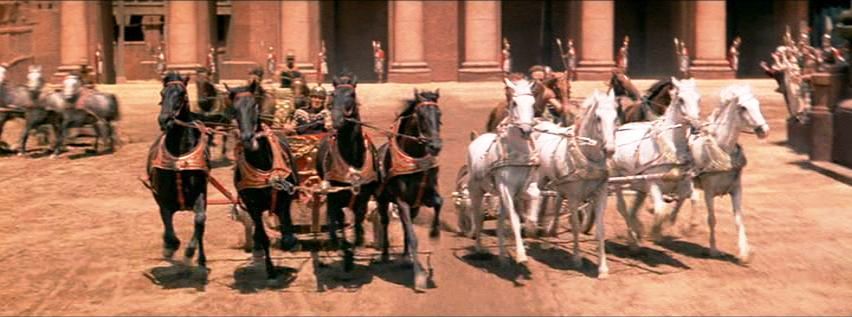
1 And again I lifted my eyes and saw, and behold, four chariots came out from between two mountains; and the mountains were mountains of bronze. 2 The first chariot had red horses, the second black horses, 3 the third white horses, and the fourth chariot dappled gray horses. 4 Then I said to the angel who talked with me, “What are these, my lord?” 5 And the angel answered me, “These are going forth to the four winds of heaven, after presenting themselves before the LORD of all the earth. 6 The chariot with the black horses goes toward the north country, the white ones go toward the west country, and the dappled ones go toward the south country.” 7 When the steeds came out, they were impatient to get off and patrol the earth. And he said, “Go, patrol the earth.” So they patrolled the earth. 8 Then he cried to me, “Behold, those who go toward the north country have set my Spirit at rest in the north country.” Zech 6:1-8
In the last of eight visions, Zechariah again talks with the same angel we saw in the previous visions. Zechariah sees four chariots with red, black, white, and dapple gray horses “come out” between two bronze mountains.
After presenting themselves before the LORD, the chariots and horses are sent to the “four winds of heaven”. We are told the horses are sent to carry out the LORD’s purposes. They appear to be either active agents of peace or somehow involved in the exile and the gathering of the Jews. These four winds of heaven always have to do with exiling and gathering [Jer 49:36 Eze 37:9; Dan 7:2, 8:8; Matt. 24:31; Rev 7:1ff]
FYI: North, West, and South of the cardinal compass ppoints are mentioned; however, there is no mention of the direction east.
The red horse of Zechariah’s first vision [Zech 1:8] has a man identified as the angel of the LORD as its rider. Here, the red horse does not appear to be sent out; but by default seems to patrol Judah.
While we are not told that the chariots and horses perform any specific tasks beyond patrolling, the horses’ colors suggest there may be a reason for their specific colors. Red is often symbolic of war or bloodshed, black of death, white of righteousness and strength, and dappled gray of pestilence. [Rev. 6]
FYI: Chariots with horses have been referred to in war and in judgment of nations. [Is. 66:15; Jer.. 47:3, 50:37; Ezek. 23:24, 26:7-10; Joel 2:5]
The chariot with the black horse is mentioned as “going towards the north,” which is associated with Egypt. The north is associated with Babylon [Is. 14:13; Jer. 6:1,22]. To get there, you must go north through Damascus, because crossing the Syrian desert is not an option. This horse has accomplished its mission to bring my Spirit to rest; Babylon was indeed at rest at this point.
The chariot with the white horse is next and is “going towards the west.” There is no empire or nation to the west of Judah. In fact, the only thing west is the Mediterranean Sea. The sea at the time of Zechariah was, for all intents and purposes, the realm of the Phoenician/Canaanites. They ran their large trading empire out of Tyre. But all this was going to change as the Greeks rose to power. Alexander the Great took Tyre in one of the most famous battles in history. Tyre was in two parts: a mainland town and an Island off the coast of Lebanon. Alexander’s men dismantled the mainland town and built a causeway to the Island, taking 7 months to do so. The island has remained uninhabited since then. After this defeat, the Phoenicians moved their center of operations to Carthage (North Africa). What remained of the people of Tyre rebuilt their city a little north of the old, as the causeway moved the course of the currents and made the area around what had been Tyre too shallow. The New Tyre continued to be an important shipping center.
The chariot with the dappled horse is mentioned as “going toward the south.” The south has traditionally been associated with Egypt. At this time of Zechariah, it was ruled by the Medo-Persians.
No horse patrols to the east; the east was primarily the Syrian desert.
The two mountains stand as sentinels, through which the chariots with their horses come from between. These mountains are reminiscent of Mt. Ebal, the mountain of the curse, and Mt. Gerizim, the mountain of blessing [Deut 27-29].
…”I have set before you, and you call them to mind among all the nations where the LORD your God has driven you, and return to the LORD your God, you and your children, and obey his voice in all that I command you this day, God will restore your fortunes, and have compassion upon you…… then the LORD your God will restore you…. bring you into the land which your fathers possessed…. make you more prosperous and numerous than your fathers… and the LORD your God will put all these curses upon your foes and enemies who persecuted you….” from Deut. 30
It is a reminder of the choice between life and death. This is also where they are prophetically being brought back into the land after 70 years of punishment because of idolatry. This is a reminder that far more judgment is to come. They will be at the will of the other bestial nations for 2520 years.
The horses that went to the north country have caused the angel of the LORD’s Spirit to be at rest. In the previous chapter, we saw the ephah return to Babylon. The wickedness of paganism and idolatry has been returned to the plains of Shinar. The LORD’s Spirit is at rest as His will was accomplished there; idolatry never returned to Judah. The city itself has begun its long decline under the Medo-Persian Empire. For a short time, Alexander the Great will start to rebuild the great city of Babylon. His plans were short-lived, as he died there. When the Romans came into the area, the city was nothing but a ruin, forgotten by the ebb and flow of the empire.
The eight visions of Zechariah have been a reminder that those who have returned from Babylon. While they have returned to the land, their return is conditional. It must be met with continual repentance and renewal of their sacred covenants. The Temple will be rebuilt, the priesthood restored, and Jerusalem will once again prosper. But always under the thumb of one Empire after another. Till 1948.
Blessed is he who waits and comes to the thousand three hundred and thirty-five days. Dan. 12:12