
An Introduction to The Olivet Discourse
Matthew 24; Mark 13; Luke 17:22-37, 21:5-38
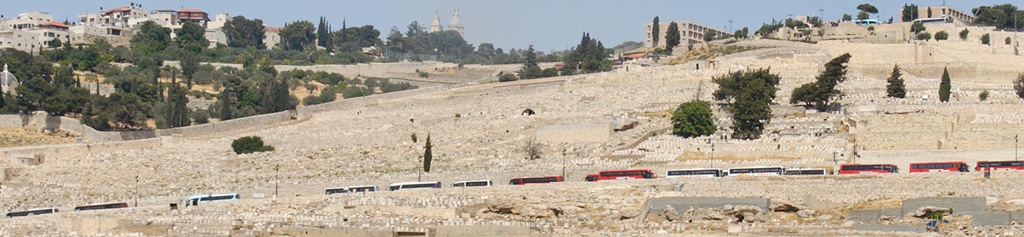
This prophecy, commonly known as the Olivet Discourse, was imparted by the Messiah to His disciples as they were walking toward the Mount of Olives. The historical -grammatical context of the passage is that the disciples are discussing the grandeur of the Temple. However, the context surrounding the question actually begins in chapter 21. It was the week of Passover, and Jesus was riding on the colt of an ass into Jerusalem known as “the Triumphal Entry.” The scene was fit for a King, and the crowds were recognizing Him as their king.
The context is important. The Passover was approaching. The triumphal entry occurred on Nisan 10, the same day that all of Israel is to examine and choose their lambs to check for spots or blemishes. All the people had one question: Is this the One? Or is He imperfect? Under this consideration, Messiah entered the temple premises to present Himself for this inspection. He taught for three days. His subject, as always, was The Kingdom of Heaven. Standing before them, He began this series of teachings, for four days, ending with the final lesson given to His disciples, on the Mount of Olives. At least that’s how Matthew recorded it. Luke, however, records the teachings at two different times. From this discrepancy, we understand that Messiah gave these teachings more than once.
This discourse, or conversation, occurred in the context of 1st-century Temple worship in Judea under Roman rule. For around 200 years before our Messiah was born, there was a considerable amount of Jewish literature that explored the meanings of the “Days of Messiah.” There is evidence of a great expectation for the coming Messiah and His kingdom. These teachings presented a grand view of the universal acceptance of His rule and the political power of the people of Judea. The idea that the Kingdom would extend to all mankind was lost to them. The Law being written on our hearts, a new spirit of forgiveness and righteousness, was not perceived by these same Jewish expositors. They had misunderstood the figurative language of the prophets; instead, their interpretations were woodenly literal. They saw Messiah’s reign as the subjugation of the nations, with the Jewish people receiving all the wealth and power that the conquered peoples could send. It was nationalism injecting itself into theology. They saw nothing of the repentance, spiritual growth, and universal mercy that Messiah actually came to teach. They did not understand Isaiah’s teaching that His house would become a house of prayer for ALL peoples/nations. [Is 56:6-7] They missed the “good tidings of great joy, which shall be to all people.”[Luke 2:10]
The lesson to be learned from these ancient Jewish expositors is that we must be careful not to fall into the same common mistake of egocentric hermeneutics. Egocentric hermeneutics is one of pride. It is when “we“ or “I” are thought to be individually or corporately important. Pride of nation, pride of denomination, pride of position, all these can sneak in and pollute clear thinking. This pride can cause a certain amount of disregard for the historical grammatical context of a passage. The truth is, each book is written to certain people at particular times and places and was intended for their exhortation. They thought the information important enough to preserve for others who would come after them. There is wisdom to be learned in all of Scripture, but not every passage is directed to us.
Context
The Olivet Discourse was written to people in the 1st century. Matthew was written to Jews. Mark was written for a general audience. Luke was written to a Gentile named Theophilus. We must not forget that we are reading someone else’s mail. The Olivet Discourse was most likely delivered in Aramaic, or possibly Hebrew, and not Greek, and certainly not in 21st-century American English. That makes it incumbent upon us to understand how they understood what was written down. Their phrases and idioms were quite different from ours. Think of it, as if someone were to tell you that we had a new toy that was hotter than a little red wagon and going to sell like hot cakes? Would you think we were talking about wagons or pancakes? All languages work like this. They are full of odd expressions and unfamiliar terminology. The Bible is no different. It does no good to say one interprets the Bible literally if one does not account for these language, culture, and historical oddities. The disciples understood when and where they were. The immediate history and geography were where they lived and walked. The questions the disciples asked at that time are not what we would ask 2000 years after the event.
Order
Like prophetic bookends, the preceding and following chapters surrounding Matthew 24 frame our Messiah’s teachings.
The proceeding starts with The Triumphal Entry of our Lord into Jerusalem, beginning in chapter 21, which establishes the setting for how and why Jerusalem is to be destroyed. After the Discourse, chapters 24 and 25 give 4 additional parables to encourage the readiness of His followers for the final Kingdom of Heaven and the future judgment of nations.
- Faithful and Wise Servant Matt. 24:45-51
- The Ten Virgins Matt. 25:1-13
- The Parable of the Talents Matt. 25:14-31
- The Judgment Matt. 25:31-46
The focus of Jesus’ teaching was that the kingdom the Elders had constructed around the temple was about to be destroyed. A Spiritual Kingdom was about to be established upon the New and Everlasting Covenant. But what shocked His audience to their foundation was that this new kingdom would not be Jewish in nature. The temple ritual sacrifices were to be “forsaken,” and the Kingdom of God was to be given to another “nation.”
Therefore I tell you, the kingdom of God will be taken away from you and given to a nation producing the fruits of it.” Matt. 21:43
Behold, your house is forsaken and desolate. Matt. 23:38
Hermeneutics
Correct understanding of the prophecy depends on correct Hermeneutics, or what rules of interpretation one uses. We teach the Historicist view, a.k.a. the Historical Protestant Interpretation. Most of the post-modern church’s teachings are from the Futurist’s point of view. If one is familiar with their teachings, one will notice significant differences in interpretation, especially with the symbolism and when events are to occur. See Also: Hermeneutics, for full definitions and explanations of these schools of interpretations.
The Futurist interpretation believes that the prophecy in Matthew 24 is about our time and our government. We take a more narrative approach to this passage. We will champion a more reasonable historical grammatical reading. We do not find a seven years tribulation, political antichrist, or rapture here. These events/people are not in the actual passage in question.
Although Futurists claim to “interpret the Bible literally,” they abandon this ultra-literal interpretation when it comes to this passage and many others. They ignore that the passage starts with a question about the very Temple in view of Jesus and His disciples.
And as he came out of the temple, one of his disciples said to him, “Look, Teacher, what wonderful stones and what wonderful buildings!” And Jesus said to him, “Do you see these great buildings? There will not be left here one stone upon another, that will not be thrown down.” Mark 13:1-2
Instead, they seek to rebuild a new temple to fulfill this prophecy. That causes their interpretation of the 1st century Temple that Jesus was referring to, symbolic or figurative, not literal. That is not physically possible.
Four points need to be considered:
1. The immediate context of this discourse is about the Temple in Jesus and the disciples immediate view
2. Applying the hermeneutical principle that the next event the prophecy describes, most likely fulfills the prophecy
3. An understanding of what “Daniel the prophet spoke of” [Dan 9:27]
4. Mark and Luke’s parallel passages concerning armies surrounding Jerusalem [Mk 13; Lk 17:22-27; 21:5-38]
Historical Background
Jesus was not a Christian. He was a first-century Judean rabbi whose name in Hebrew is Yeshua. He would have been considered to be closest in theology to the faction of the Pharisees, but at times he sided with the Sadducees.
The Pharisees believed and taught both the Torah, i.e., the First Five Books of the Bible, and the Oral Law, i.e., the Talmud. They maintained a firm belief in a resurrection and an afterlife. They thought, and still teach, that the coming of the messiah would/will bring world peace.
Sadducees are more difficult to understand, as they ceased to exist as a faction after the destruction of the Temple in 70 AD. Only minute amounts of their writings can be found, as the Pharisees did not preserve the Book of the Sadducees. What we know of their beliefs is that they rejected the Talmud and insisted that the Torah be read literally. They also rejected a resurrection and an afterlife, as they did not see that they are mentioned in the Torah. The Sadducees were the priestly class and were responsible for the administration of the Temple; their chief concern was that the rituals of the Temple be observed properly. They were also willing to compromise with the Hellenists in the adoption of Greek culture of dress and eating habits.
FYI: A fact often lost to many churchgoers is that the religion known as Judaism is not the temple worship of the Bible. Christianity is, in fact, older than Judaism. Judaism is a completely different religion from what went on in the temple with its ritual sacrifices and washings. It was developed in the 2nd century in Palestine, after the failure of the Jewish Bar Kochba rebellion against Rome in 137 AD. When they failed to regain the temple, they needed something to hold the people together. So a system of prayers and readings was created to replace the rituals.
The actual Discourse is in four different passages [Matthew 24, Mark 13, and Luke 17:22-37, 21:5-37]. Each of these versions is slightly different. This is a clear indication that the sermon was given on more than one occasion. The four passages offer cross-referencing of Jewish phraseology that aids immensely in the interpretation of the events. It is essential to read all four passages to fully study what our Messiah was communicating to those standing before Him.
Next Week: The Triumphal Entry