14 bidding them make an image for the beast which was wounded by the sword and yet lived; 15 and it was allowed to give breath to the image of the beast so that the image of the beast should even speak, and to cause those who would not worship the image of the beast to be slain. Revelation 13:14b, 15
The English here is a little ambiguous. Is this an image that looks like the beast, or is it an image that belongs to the beast? However, in Greek, image, i.e., elkoni, is in the dative, meaning that the image belongs or is made by the beast. The beast here is the seven-headed imperial beast and not the beast from the earth. Although at this point, that seems to be a distinction without much of a difference. Since all three beasts are trying to deceive people into false worship.
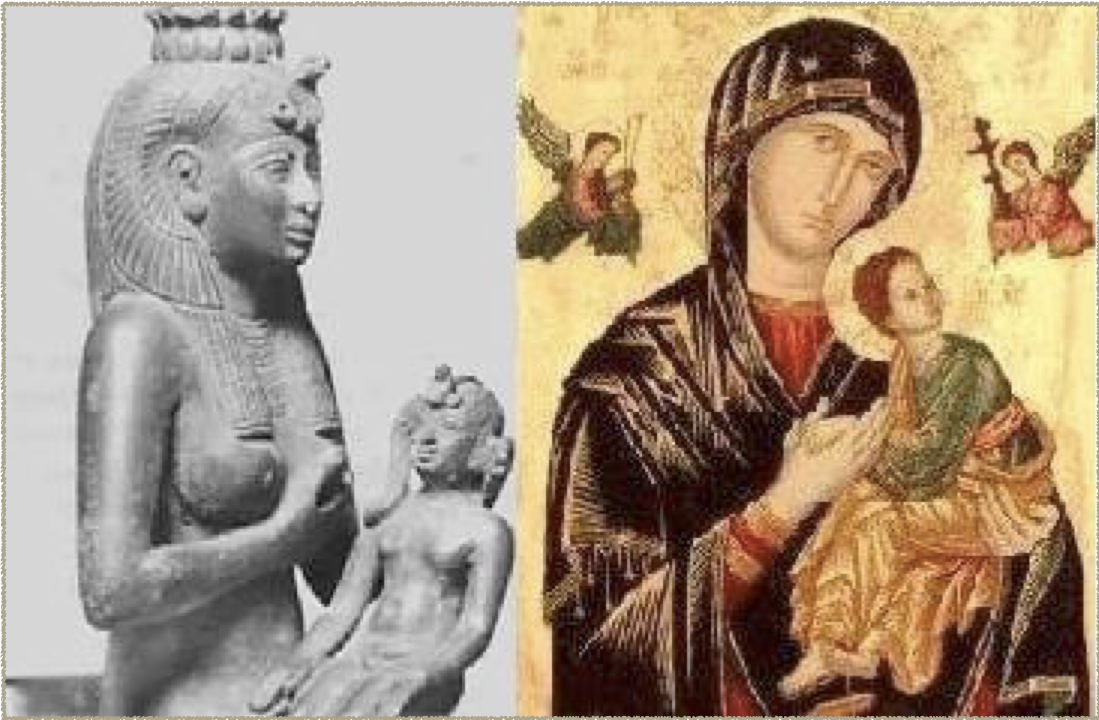
The same images of false religion and paganism appear and reappear throughout the history of man. They may be disguised, but they continue seeking the worship of Satan.
Hislop explains the pagan origin of the Madonna of the Roman Catholic Church.
“The image of the beast is the Virgin Mother, or the Madonna. This at first sight may appear a very unlikely solution; but when it is brought into comparison with the religious history of Chaldea, the unlikelihood entirely disappears. In the old Babylonian Paganism, there was a image of the Beast from the sea; and when it is known what that image was, the question will, I think, be fairly decided. When Dagon was first set up to be worshipped, while he was represented in many different ways, and exhibited in many characters, the favorite form in which he was worshipped, as the reader well knows, was that of a child in his mother’s arms. In the natural course of events, the mother came to be worshipped along with the child, yea, to be the favorite object of worship. To justify this worship, as we have already seen, that mother, of course, must be raised to divinity, and divine powers and prerogatives ascribed to her. Whatever dignity, therefore, the son was believed to possess like dignity was ascribed to her. Whatever name of honor he bore, a similar name was bestowed upon her. He was called Belus, “the Lord;” she, Beltis, “My Lady”. He was called Dagon, “the Merman;” she, Derketo, “the Mermaid.” He, as the World-King, wore the Bull’s horns; she, as we have already seen, on the authority of Sanchuniathon, put on her own head a bull’s head, as the ensign of royalty. He, as the Sun-god, was called Beel-samen, “Lord of heaven;” she, as the Moon-goddess, Melkat-ashemin “Queen of heaven.” He was worshipped in Egypt as the “Revealer of goodness and truth;” she, in Babylon, under the symbol of the Dove, as the goddess of gentleness and mercy, the “Mother of gracious acceptance”, “merciful and benignant to men.” He, under the name of Mithra, was worshipped as Mesites, or “The Mediator;” she, as Aphrodite, or the “Wrath-subduer,” was called Mylitta, “the Mediatrix”. He was represented as crushing the great serpent under his heel; she, as bruising the serpent’s head in her hand. He, under the name Janus, bore a key, as the opener and shutter of the gates of the invisible world. She under the name of Cybele, was invested with a like key, as an emblem of the same power. He, as the cleanser from sin, was called the “Unpolluted god;” she, too, had the power to wash away sin, and though the mother of the seed, was called the Virgin, pure and undefiled. He was represented as “Judge of the dead;” she was represented as standing by his side, at the judgment-seat, in the unseen world. He, after being killed by the sword, was fabled to have risen again, and ascended up to heaven. She, too though history makes her to have been killed with the sword by one of her own sons, was nevertheless, in the myth, said to have been carried by her son bodily to heaven, and to have been made Pambasileia, “Queen of the universe”. (Horus, in Egypt, is said to have cut off his mother’s head, as Bel in Babylon also cut asunder the great primeval goddess of the Babylonians). Finally, to clench the whole, the name by which she was now known was Semele, which, in the Babylonian language, signifies “THE IMAGE”. Thus, in every respect, to the very least jot and tittle, she became the express image of the Babylonian “beast that had the wound by a sword, and did live.” The Two Babylon’s or Papal Worship by Rev A. Hislop pg 265